Walkie is a real-time matching app for the journey home. It connects women travelling the same route at the same time so they can do it together, on foot, by bus or by metro. The simplest analogy: BlaBlaCar, but for the last mile home, in the evening, with verified identities and a safety layer built in.
A personal project taken from an initial idea to a working prototype single-handed, using an AI toolchain end to end.
The starting problem is structural. In Italy, 67.3% of women say they are afraid when walking home in the evening, and 38% have given up going out because of the journey back (Censis, 2025).
Already available virtual escort apps offer company over video call, SOS apps send alarms, navigation apps suggest better-lit streets but none of them focus on finding someone to walk with.
Before defining the product I ran a primary survey and benchmarked more than twelve competing apps across Italy, Europe and North America. Three findings shaped every decision that followed.
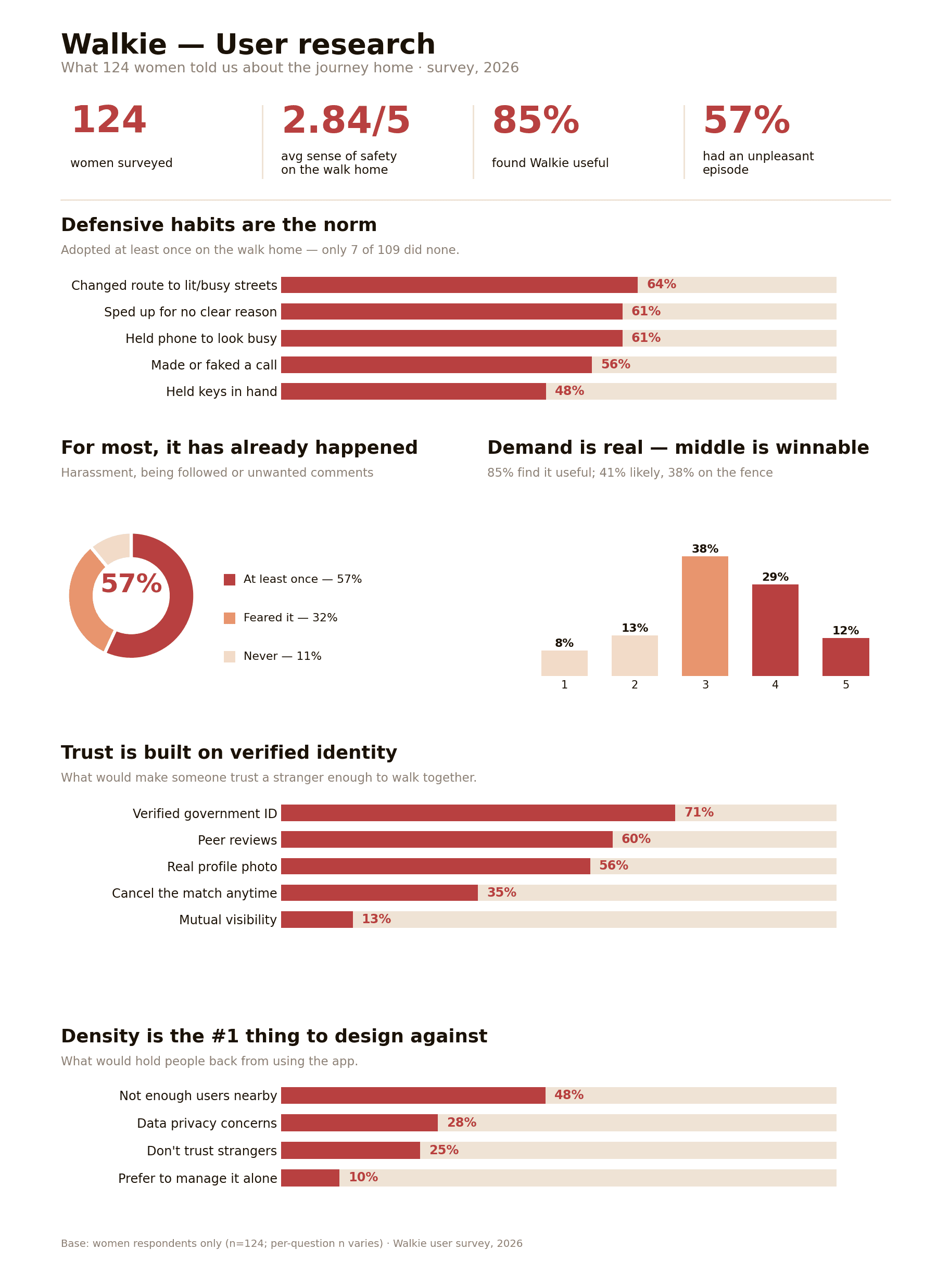
The behaviour already exists. People already look for company on the way home and the product had to support an existing behaviour rather than introduce a new one.
Trust is built on identity. The most cited trust factors were a verified ID document (85 mentions), reviews from other users (72), a real profile photo (67), and the ability to cancel a match at any moment (42).
The obstacle is density, not willingness. Lack of company was the leading barrier (58 mentions), followed by data privacy and wariness of strangers. The strongest qualitative concern was the risk of predatory use: someone downloading the app specifically to locate women travelling alone.
User survey: sense of safety on the walk home averages 2.84 out of 5.